SEBI 2025 Proposed Amendment: Angel Funds Restricted to Accredited Investors
SEBI’s 210th Board Meeting (June 2025) would act as a precursor to one of the biggest overhauls of the angel investing lansdcape in India. The Board has in its meeting approved the proposal to mandate that all investors in Angel Funds must now be “Accredited Investors”. This move marks a pivot away from the old, self-declared status of “Angel Investor” to a formalized, independently verified classification.
What is the Reason for the Proposed Amendment?
The previous framework, which defined an “Angel Investor,” was established in 2013. While it served its purpose at the time, it had become increasingly inadequate in the face of a rapidly maturing and expanding startup ecosystem. The core problems were two-fold, as detailed in SEBI’s press release :
Absence of Independent Verification: Under the old system, there was no verification as to whether an investor truly qualified as an Angel Investor. This lack of independent third-party validation placed the onus of compliance entirely on the fund manager, creating a potential for regulatory gaps and oversight challenges.
Outdated Economic Thresholds: The financial benchmarks set in 2013, such as the minimum net worth of INR 2 crore for individuals and INR 10 crore for body corporates, had not been updated to reflect the changed market indicators. This meant the criteria for a qualified investor were no longer in sync with the current economic landscape,
Who are Accredited Investors?
Meaning: An Accredited Investor (AI) is a sophisticated class of investor recognized for their financial capacity and ability to make informed decisions regarding high-risk financial products. The concept is globally recognized, and in the Indian context, it represents a formal acknowledgment of an investor’s ability to participate in investment products with a “regulation-light framework”. The accreditation process is voluntary and grants an investor access to exclusive financial products and services.
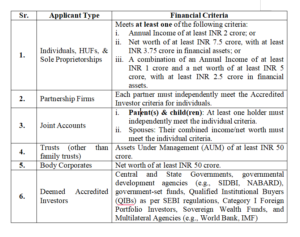
Eligibility Criteria: The following table provides a comprehensive overview of the qualifying criteria:
Eligibility Criteria for Accredited Investors in India
Note: The criteria for individuals, HUF, and sole proprietorship explicitly excludes the value of their primary residence.
How does an Investor become an Accredited Investor?
The process of becoming an Accredited Investor has been streamlined to make it efficient and verifiable. The responsibility of this process falls on specialized entities known as Accreditation Agencies. The process for a prospective investor to become an Accredited Investor is predominantly digital and involves several distinct steps:
Online Application: The investor must apply online through the Accreditation Agency’s portal (e.g. aia.cvlindia.com). They must register with their name, PAN, Date of Birth, Email, and contact number to obtain the log-in ID and credentials.
Document Submission: The applicant must upload a comprehensive set of documents based on their investor type. An indicative list of required documents include:
PAN Card;
Aadhar of individual/authorized signatory;
Trust Deed / Certificate of Incorporation / Partnership Deed (as the case may be, if applicable);
Letter from authorized signatory (for trusts, LLPs and companies);
Income Tax Returns (recommended to keep the last 3 year tax returns handy; not applicable to trusts other than family trusts, companies and LLPs; the exempted entities have to provide their audited financial statements)
Net worth certificate (not older than 6 months) from a practicing Chartered Accountant along with calculation of net worth to be given attached as an annexure;
Undertaking verifying the information provided as true (format available on the CDSL website).
Verification and Issuance: The Accreditation Agency verifies the financial and personal documents submitted. If the application is approved, the agency issues an Accreditation Certificate with a unique number and a specific validity period.
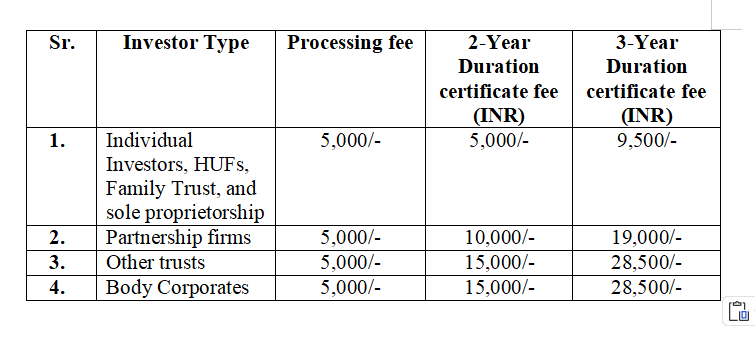
Tariff Structure: The accreditation can be availed for a two or a three year period at once after which the certificate becomes due for renewal with the same tariff structure. Following charges are applicable as on date:
Tariff Structure for Accredited Investor Certificate
Can Angel Funds verify if an Investor is Accredited?
Once the proposed amendment becomes the norm, all investors in an Angel Fund will have to be accredited which makes it important for the Fund (“Investment Provider”) to be able to verify the certificates issued to the investor before giving them the benefits attached with accreditation. This makes it important for Investment Providers to also register themselves with the Accreditation Agency to be able to verify the authenticity of the issued certificates.
As per Clause 4.18.4 of the extant Accreditation framework, “investment provider shall verify directly from the Accreditation Agency that the certificate furnished by the prospective investor is indeed issued to that particular investor and accreditation status corresponding to the specific certificate number is valid as on the date of verification. The investment provider shall ensure that the prospective investor has a valid Accreditation Certificate before entering into a client agreement offering benefits linked to accreditation.”
Procedure: The Investment Provider would be able to submit verification request on the Accreditation Agency website from whom the certificate is received. On submission of request, the link would be sent to the concerned investor for consent. On receipt of consent, the Investment Provider would have to proceed to make the payment. After the payment is successful, the certificate details would be displayed / provided to the Investment Providers.
Tariff Structure:
One Time Fees: INR 5,000/-
Annual Charges: INR 2,000/-
Verification Charges: INR 500/- per certificate
Impact on the Angel Fund Lanscape
SEBI’s decision to mandate Accredited Investor status for all investors in Angel Funds is a pragmatic and strategically nuanced step forward for the Indian financial ecosystem. It replaces a flawed, self-attested system with a standardized and independently verifiable framework, fundamentally enhancing investor protection and market transparency. This move balances the dual objectives of safeguarding investors and fostering the growth of the startup ecosystem. However, with the current criteria to qualify as an accredited investor being extremely steep, such a mandate might lead to investors and fund managers to think twice before considering angel fund as their preferred fund structure.
Note: This article is intended solely for general informational purposes and does not constitute legal, financial, or investment advice. Readers are advised to consult with qualified legal and financial professionals before making any decisions based on the information provided herein.
Mr. Akshay is a corporate lawyer hailing from Campus Law Centre, University of Delhi specializing in M&A, PE and VC transactions. He also advises Companies and LLPs on legal compliance and intellectual property protection.