
Commercial contracts form instruments for risk allocation. Parties to any contract negotiate terms regarding the consequences that are to be borne when these contracts may fall short of reality. I believe that three categories of clauses: representations and warranties, indemnity, and boilerplate clauses form a strong foundation and framework on which any agreement rests.
This article goes through each of these categories and analyses how these three contracts come together in the course of a commercial transaction.
While the terms representations and warranties are often paired together, there is a stark difference between the two. As per the judgment in Behn v Burness, representation is an assertion of past or existing fact, made by one party to a contract to the other, before or at the time of the contract, relating to the subject matter of the contract. On the other hand, a warrant is a promise of indemnity if the assertion is false. Therefore, in case a representation is false, it is inaccurate, whereas a warranty is breached.
While warranty is not defined in the context of a commercial agreement in the Indian Contract Act (hereinafter “ICA”), S.17-19 do address the consequences of fraud, misrepresentation, and mistake.
S.17 broadly defines fraud to include active concealment of a material fact by a party who has knowledge or belief of the same. S.18 defines misrepresentation as including an unwarranted assertion of a fact, and causing a party to make a mistake as to the subject matter of the contract.
What is essential here is that under S.19 ICA, a contract induced by misrepresentation is voidable, and not void, thereby meaning that it is up to the defrauded party to decide on the validity of the contract. However, the proviso to the same states that where, under ordinary due diligence, the information could have been ascertained by the defrauded party, the option to rescind the contract may not be available.
In commercial contracts, qualifiers are ‘limiting terms’, for instance: ‘to the best of knowledge’, ‘materially’, ‘reasonable efforts’. These help in narrowing liability over minor breaches, provide flexibility in performance, and allow parties to allocate risk reasonably for things that are outside their control.
The following table illustrates common types of contract qualifiers:
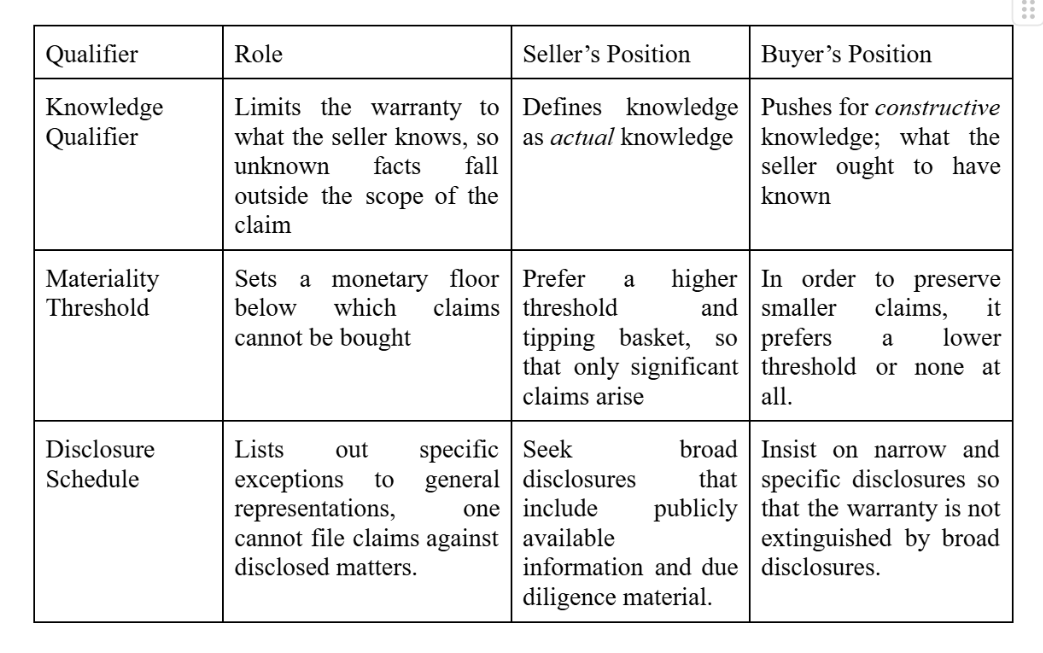
In the case of the materiality threshold, Talwar and Joshi explain that a tipping basket is commonly used in Indian M&A transactions. The concept of a tipping basket basically states that the threshold becomes claimable once the aggregate of individual claims crosses the higher limit stated in the contract.
While representations and warranties do not find a place within the Indian Contract Act, indemnities have been explicitly recognised within the same. S.124of the Act define a contract of indemnity as a contract by which one party promises to save the other from the loss caused by the promisor’s conduct or by the conduct of any other person.
S.125 outlines the rights of the promisee (indemnity holder) when sued, and allows them to recover all damages, costs, and sums paid under a compromise from the promisor (indemnifier). However, to claim these rights, the condition is that the indemnity holder must act prudently and follow the indemniifier’s directions.
However, the statute provides a quite narrow scope to the contractual indemnities that are encountered during transactional practice. While S.124 specifically confines itself to losses causes by the indemnifier or a third party, it does not expressly extend to the losses caused by other events. However, in the Gajanan Moheshwar case, it was held that the provisions of the ICA were not exhaustive of the law of indemnity and courts may apply the same equitable principles as applied by English Courts. This expansion is a legitimate exercise of S.10 of the Act; freedom of contract.
One of the most substantial distinctions within Contract Law is between an indemnity and a claim for damager. S.73 of the ICA requires the claimant to mitigate its loss and limits their recovery only to losses that arise naturally from the breach of the other party or were within the reasonable forseeability of the parties. However, an indemnity is drafted to provide a wider measure of recovery to the indemnity holder, and includes indemnification for legal costs, and losses that may not qualify under S.73.
In the Gajanan Moheshwar case (supra.) by the Bombay High Court held:
“It is clear that this might, under certain circumstances throw an intolerable burden upon the indemnity-holder. He might not be in a position to satisfy the judgment and yet he could not avail himself of his indemnity till he had done so. Therefore the Court of equity stepped in and mitigated the rigour of the common law.”
This draws a sharp contrast to S.73, which requires an actual monetary loss, and not one that is merely contingent.
One of the lesser-known functions of an indemnity clause is its role in shaping dispute resolutions, since these clauses outline who bears the loss and also define the limits of how and when a claim can be made. This helps in structuring a dispute in case one arises.
The first way an indemnity clause achieves this is that it completely negates any form of judicial uncertainty. A claim for damages under S.73 requires the court to determine what losses arose naturally from a breach of contract; this is a fact-intensive inquiry, which is time-consuming. However, an indemnity clause short-circuits this process. As per the Asian Business Law Institute, having an indemnity clause in the event of a breach of contract simplifies the dispute resolution process because the party that is relying on the indemnity does not have to establish the elements of the claim which would otherwise be required for claiming damages under S.73. Indemnity clauses make disputes faster to resolve since a clause specifies heads of recoverable losses, any caps on liabilities and the threshold below which claims are not maintainable; this ensures that parties pre-negotiate the contours of any future dispute.
The second way an indemnity clause achieves this is a temporal contribution. In case of S.73 ICA, one must prove actual loss, causation, and quantum of loss while claiming the same. However, as per the Bombay High Court in Gajanan Moreshwar (supra.), once the liability of the indemnity holder has become absolute, the indemnifier may act without first satisfying the liability itself. The Court held:
“7. It is true that under the English common law no action could be maintained until actual loss had been incurred. It was very soon realized that an indemnity might be worth very little indeed if the indemnified could not enforce his indemnity till he had actually paid the loss. If a suit was filed against him, he had actually to wait till a judgment was pronounced, and it was only after he had satisfied the judgment that he could sue on his indemnity. It is clear that this might under certain circumstances throw an intolerable burden upon the indemnity-holder. He might not be in a position to satisfy the judgment and yet he could not avail himself of his indemnity till he had done so. Therefore the Court of equity stepped in and mitigated the rigour of the common law. The Court of equity held that if his liability had become absolute then he was entitled either to get the indemnifier to pay off the claim or to pay into Court sufficient money which would constitute a fund for paying off the claim whenever it was made. As a matter of fact, it has been conceded at the bar by Mr. Tendolkar that in England the plaintiff could have maintained a suit of the nature which he has filed here; but, as I have pointed out, Mr. Tendolkar contends that the law in this country is different. I have already held that Sections 124 and 125 of the Indian Contract Act are not exhaustive of the law of indemnity and that the Courts here would apply the same equitable principles that the Courts in England do. Therefore, if the indemnified has incurred a liability and that liability is absolute, he is entitled to call upon the indemnifier to save him from that liability and to pay it off.”
This judgment helps compress the timeline of a dispute. Unlike a claim for damages, which requires a clear nexus between the breach and the loss to be demonstrated, the threshold to satisfy a claim under an indemnity clause is significantly lower and absolute liability suffices.
Indemnity clauses include notice requirements, tiered escalation mechanisms, and exclusive remedy provisions that channel disputes into a well-defined framework rather than open-ended and vast litigation. Drafting an indemnity clause in such a way that the payment obligation is only triggered once the claim notice is issued, clearly stating when the indemnifier’s obligation is due and payable, discourages speculative claims. The indemnifier should include a limitation for the remedy clause, taking into account both the limitation of liability and the exclusive remedy clause, thereby leaving no room for ambiguity in interpretation.
Taken together, these features show that an indemnity clause, while construed as a tool for risk allocation, is also a dispute resolution mechanism that is designed by the parties at the stage of negotiation.
The word ‘boilerplate’ was first used in the 19th century to describe the large metal plates used in steam boilers. Later borrowed by newspaper editors, the word was then used as a way to describe subpar or ‘standard’ work done by their team of writers. However, today, the term finds its meaning in the legal field as the most frequently used clauses that are found in most contracts.
Boilerplate clauses that concern matters such as dispute resolution, severability, and force majeure are routinely used in order to determine the outcome of commercial disputes. Nothing about these is standard, and it is at the peril of a legal professional to treat them as such. This section will now further discuss a few of the most essential boilerplate clauses.
Sometimes called an integration clause, the entire agreement clause provides that the written contract constitutes the complete agreement between the parties, and it now supersedes all prior representations, negotiations and understandings. Its primary purpose is to preclude reliance on extrinsic evidence relating to pre-contractual statements, in line with Sections 91 and 92 of the Indian Evidence Act, which restrict the admissibility of oral evidence to vary or contradict written terms. Recently, the Supreme Court in V. Anantha Raju vs T.M. Narasimhanheld:
“23. This Court has further held that Sections 91 and 92 of the Evidence Act would apply only when the document on the face of it contains or appears to contain all the terms of the contract. It has been held that after the document has been produced to prove its terms under Section 91, the provisions of Section 92 come into operation for the purpose of excluding evidence of any oral agreement or statement for the purpose of contradicting, varying, adding or subtracting from its terms. It has been held that it would be inconve nient that matters in writing made by advice and on consid eration, and which finally import the certain truth of the agreement of parties should be controlled by averment of the parties to be proved by the uncertain testimony of slip pery memory. It has been held that when parties deliber ately put their agreement into writing, it is conclusively pre sumed, between themselves and their privies, that they in tended the writing to form a full and final statement of their intentions, and one which should be placed beyond the reach of future controversy, bad faith and treacherous memory.”
However, such a clause does not bar claims arising from fraudulent misrepresentation.
S.56, ICA deals with the doctrine of frustration, which provides for the discharge of contracts on the impossibility of their performance. This section gives strength to a force majeure clause, which excuses a party’s non-performance due to the occurrence of an event that might affect the party’s ability to perform the contract, and there is nothing the party can do. The concept recognises that there are, at times, forces so far outside the control of anyone that they are not reasonably foreseeable.
In Energy Watchdog v. Central Electricity Regulatory Commission, the Court held:
“38. This view of the law has been echoed in ‘Chitty on Contracts’, 31st edition. In paragraph 14-151 a rise in cost or expense has been stated not to frustrate a contract. Similarly, in ‘Treitel on Frustration and Force Majeure’, 3rd edition, the learned author has opined, at paragraph 12-034, that the cases provide many illustrations of the principle that a force majeure clause will not normally be construed to apply where the contract provides for an alternative mode of performance. It is clear that a more onerous method of performance by itself would not amount to an frustrating event. The same learned author also states that a mere rise in price rendering the contract more expensive to perform does not constitute frustration. (See paragraph 15-158)”
The COVID-19 pandemic led to substantial force majeure litigation in the Indian Courts and arbitral tribunals, wherein the judicial requirement was threefold:
The governing law clause defines which state’s law is to prevail in the case of a conflict under the contract. This is significant in cross-border transactions where governing law clauses specify English or Singapore Laws and are paired with clauses for international arbitration under the ICC, SIAC, or LIAC rules. The enforceability of such clauses is recognised under S.28, ICA and the Arbitration and Conciliation Act. The dispute resolution clause provides for arbitration, litigation or a tiered mechanism in the even tof a dispute. These clauses outline the process for resolving disputes.
Severability clause provides that if a term in a contract is void or unenforceable, the remainder of the contract remains intact. In Indian Law, this is partly recognised under S.57 ICA, which provides that where a contract is partly void and partly enforceable, the valid portion may be severed and enforced. The clause is valuable in specifying how the parties intend to operate the severance.
A waiver clause states that just because one party does not exercise a right on one occasion does not mean that they have waived the ability to do so in the future. A party’s rights and obligations are only waived when they are in writing and executed in an authorised manner. S.63 of the ICA permits a promisee to dispense with or remit performance.
Reps and warranties, indemnities, and boilerplate clauses do not operate in isolation. In any live transaction, these three form a chain. A seller makes representations and warranties on the state of his business; if those statements prove to be false, a contractual right to indemnity is triggered; and boilerplate clauses outline the scope, measure, enforcement and limits of that indemnity or dispute in case it arises.
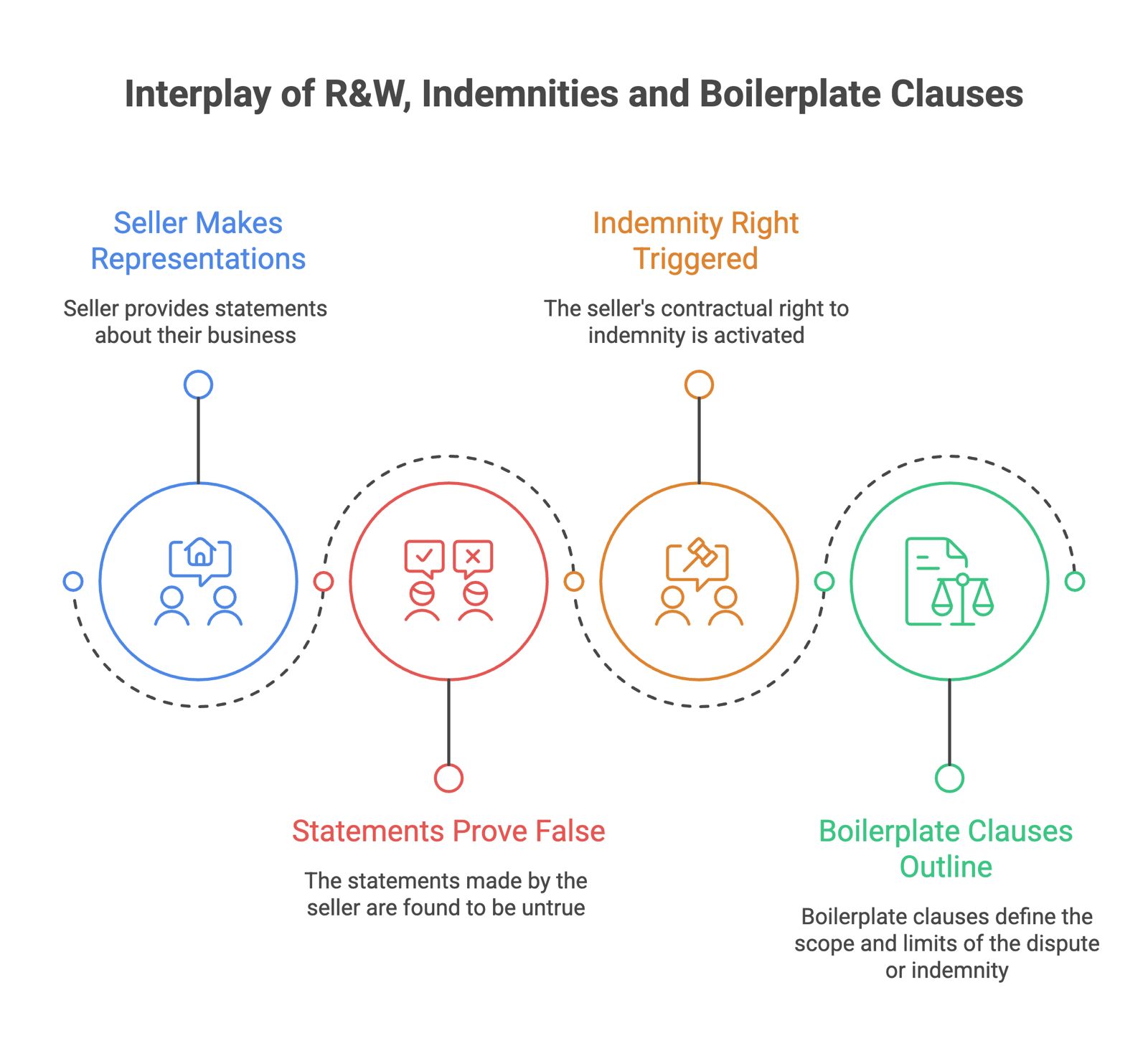
This can be perfectly witnessed in Avitel Post Studioz Ltd. & Ors. v. HSBC PI Holdings (Mauritius) Ltd, wherein an interplay of these three categories is starkly visible. While I am not discussing the facts of the case at hand, the abovementioned chain can be seen as follows:
The anatomy of a contract is not an academic exercise. Representations and warranties, indemnities, and boilerplate clauses together form the architecture for when a deal may go wrong. Over the decades, Indian Courts have developed a nuanced body of jurisprudence on each of the provisions discussed in this article. These cases do not make commercial contracts more complex; they simplify the process by placing a greater responsibility on the shoulders of the drafter.